Taken from https://historia.nationalgeographic.com
By: Abel de Medici
It is well known that Halloween derives from an ancient Celtic festival, Samhain, but that is not its only origin. The popular celebration draws on elements from various European cultures and has many parallels with an ancient Roman tradition, the mundus patet, which, like Samhain, was tied to the harvest season.
The gateway to the world of the dead
The expression mundus patet means "the world is open" and refers to the Mundus Cereris, a stone building located in the Forum. It is one of the oldest structures in Rome and marked the exact center of the city. It was believed to be the point of connection between the world of the living and that of the dead, and so for most of the year its entrance remained sealed by a great stone slab that was removed only three times a year: on August 24, October 5, and November 8.
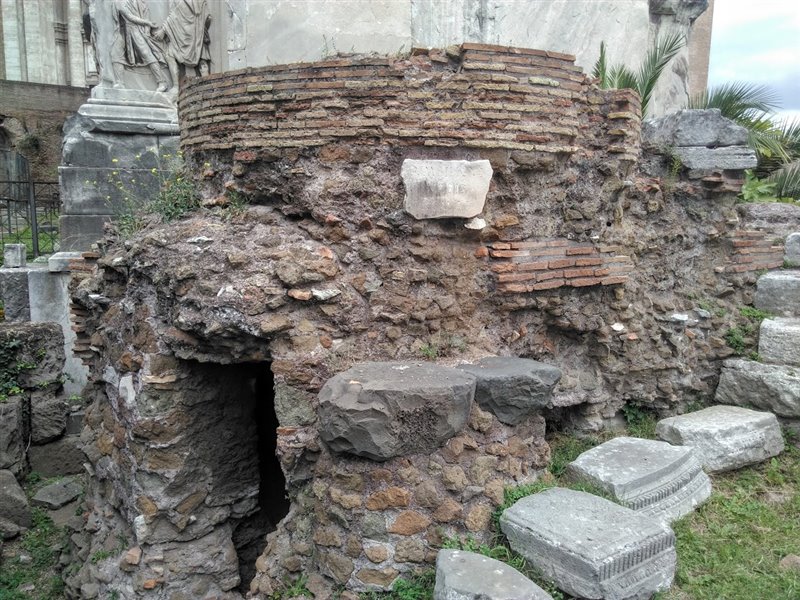
Various Roman authors offer contradictory indications as to the location of the Mundus Cereris, but based on its features it is commonly identified with the brick building also known as the "Umbilicus urbis" (the navel of the city), situated in the Roman Forum.
Photo: CC : https://bit.ly/34X4zE5
The dates were no coincidence, as they fell on days dedicated to underworld deities. Although as a general rule this entrance had to remain closed, the Romans believed that on certain marked occasions the manes (the souls of ancestors) should be allowed to return to the earth so that their favor could be won, since these spirits protected the family and guaranteed its prosperity. However, on such occasions the living had to exercise great caution, for the gate to the underworld stood open and they could be dragged into it.
According to Cato the Elder, on the days when the mundus stood open (in Latin, mundus patet), all official business and any military activity were suspended; the doors of temples had to remain closed; marriages and sexual relations were forbidden—though the latter was difficult to enforce, at least the lupanaria were shut—since the souls of the dead might feel envy and drag women down to their deaths; and any activity that was not strictly necessary was to be avoided.
The deities of the underworld
The Mundus Cereris held great symbolic importance for the Romans, as it was considered the exact spot where Rome had been born. According to legend, Romulus, the city's mythical founder, had erected it to appease the soul of his brother Remus, whom he had slain; and he had consecrated it to Ceres, goddess of the earth and agriculture, who also maintained a close relationship with the underworld.
The Romans believed that, just as plants draw nutrients from the earth to grow, so too did the world of the living need a connection with the underworld in order to survive. On one hand, the manes had to be honored so that they would protect their descendants; on the other, the deities of the earth (such as Ceres, goddess of agriculture, or Vulcan, god of volcanoes) had to be venerated so that the earth would continue to bestow its blessings and natural disasters would not occur.
In fact, the mundus patet formed part of a broader set of celebrations related to the underworld. Various Roman authors disagree on many aspects of these rites, since they date back to the earliest days of the city, possibly even before its founding. Their characteristics point to a probable Etruscan origin and to the ancestral Mediterranean cult of the Mother Goddess, from whom Ceres derives.
Similarities with Halloween
The Roman conception of the world of the dead and of the malevolent creatures that inhabited it shares many similarities with Halloween. Just as the lares were benevolent spirits, so too were there evil spirits, known as larvae and maniae: Roman sources describe the former as "spectres that feed on the life of mortals," while the latter took the form of "hideous skeletons that kindle madness in the living."
There were also the dreaded lemures, souls that could find no rest on account of their violent deaths and continued to wander the earth tormenting the living. Their appearance and behavior corresponds to what we would today call ghosts, but they also bear similarities to vampires in that, unlike other beings of the underworld, the lemures were specifically nocturnal, and their very name means "spirits of the night." There was a festival dedicated specifically to appeasing them, the Lemuralia, which took place on May 9, 11, and 13.
A special case arises with witches, who in the Christian tradition have always been associated with evil, whereas in the Roman world they occupied a more ambivalent position. They were priestesses initiated into the mysteries of magic, which they could employ equally for good or for ill. Literature attests that the Romans feared them for their supposed powers, and in particular for their knowledge of necromancy—the magic of death—with which it was believed they could steal the lives of newborns (hence the literary trope that witches hate children). Yet within that fear there was also a certain respect for their supposed powers of divination and mediation with the dead, and it was believed that gifts prepared by them, especially sweets, helped to appease the evil spirits so that they would leave the living in peace: the famous "trick or treat."
Although historiography tends to present Romans and Celts as enemies—and they certainly were—both cultures also influenced each other. Many of the oldest Roman traditions were bound up with the harvest and the turning of the seasons, since long before becoming an empire Rome was a people of farmers and herders, just like the Celts. Both shared the conviction that the blessings the earth gave them had to be acknowledged and shared with one's ancestors, allowing them from time to time to return to the world of the living and, if necessary, winning them over with a sweet.