Interview first published in September 2018, in issue 12 of El Ciervo Blanco magazine.
Cuba is an island of wonders that never stops surprising you. Saying so is stating the obvious, but what follows is always something new. In Cuba lives Alexander Suarez Méndez — an ordinary enough name, until it appears alongside others such as Gay McKeon, Paddy Keenan or Liam O'Flynn, at which point it takes on a very particular significance. Not that the Cuban needs outsiders to shine on his own merits; the trouble is that "we" are so often incapable of recognising our own talent — it takes someone from "outside" to point it out.
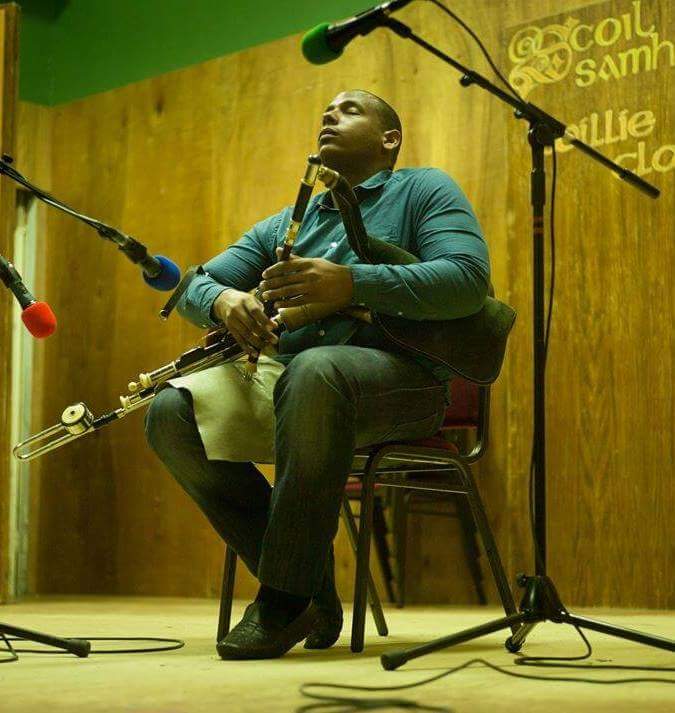
Alexander is one of the most respected pipers in Havana. More than one person will have seen him in a park giving lessons on the instrument and thought it an eccentric hobby, never suspecting that the seriousness of his work led him last year to perform at the residence of Irish president Michael D. Higgins.
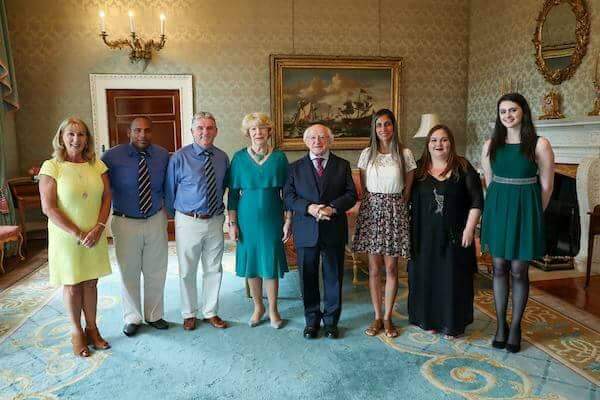
Perhaps because his art falls outside the catalogue of Cuban clichés, and because he owes his musical career to no state institution, Alexander is a talented Cuban artist who does not receive the attention he deserves. Given how many Cubans love and long for Celtic music, it would be a disservice — to us and to him — if his story remained just another "curiosity" that Arturo Sotto or Julio Acanda will one day describe as surrealist in a documentary or television programme.
Accustomed as we are to thinking small and to taking only what "our ration book entitles us to", we miss a great deal. Alexander refused to settle for that, and hand in hand with his teacher Gay McKeon he has caused a sensation in Ireland: he went from taking classes to giving them, and the site http://www.irishmusicmagazine.com considers him an "experienced traditional musician".
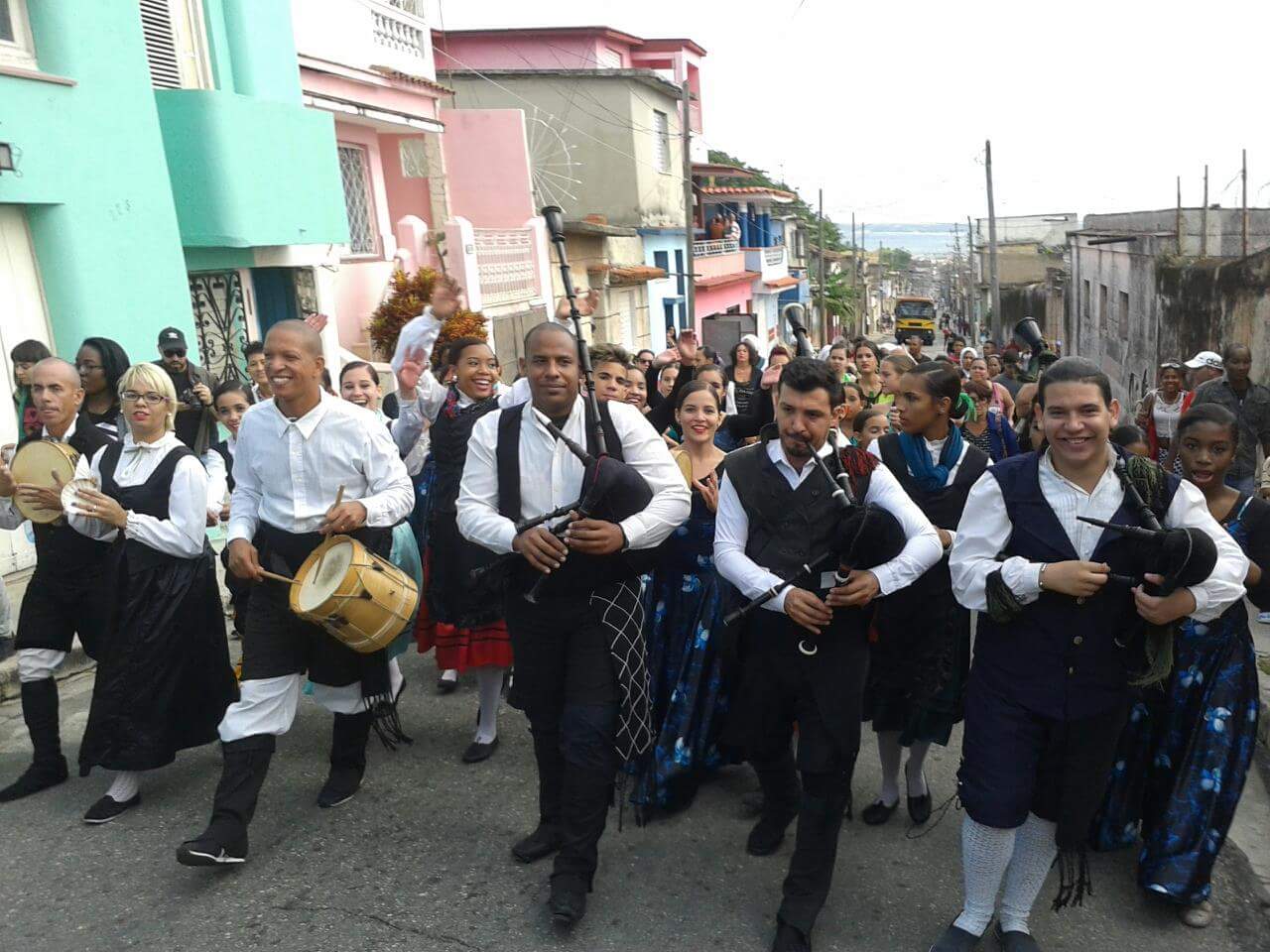
Alexander works today at the Lutherie Workshop of the Office of the Historian of Havana, yet he has never left the Galician bagpipe band Eduardo Lorenzo, which he has belonged to since 2004, nor has he stopped giving free lessons to anyone who is interested. He and other pipers seize every cultural event organised by the Spanish embassy and Spanish societies as an opportunity to display their art. In El Ciervo Blanco's experience, Alexander belongs to a scattered — though by no means small — number of musicians (and artists) who want to champion Celtic culture but do not believe it is possible in Cuba, or simply lack the resources. The sad part is that there is also a potential audience waiting for them, an audience that in the meantime asks itself, with a mixture of fear and resignation: what will be Chocolate's next "hit"?
El Ciervo Blanco is proud and grateful to have had the opportunity to interview Alexander — this kind of ambassador of the palm tree and the shamrock — who shows us that you need not stop being Cuban to dream of green Erin and the sound of the uilleann pipes.
"It's not about replacing one culture with another…"
How did you come to the bagpipes?
I entered the world of the bagpipes in 2004–2005 through the documentary Los últimos gaiteros de La Habana; that was how I found out the instrument existed here. I had heard it, I had seen it in films, but I had no idea it was here, so I started going round the [Spanish] societies to see which ones had a bagpipe group, and I ended up at the Galician Arts Association, where I began playing the Galician bagpipe proper. I have been there ever since, playing with the Eduardo Lorenzo band, directed by Alejandro Gispert.
Did you have any musical training?
No, I started with the bagpipes.
What has the learning process been like — moving from one set of pipes to the other?
The process is a long one; you learn something new every day. In April or May of 2010 a Celtic music festival was held here in Cuba, in Havana, with the Office of the Historian, organised by the Irishman Killian Kennedy, and Irish, Canadian and Spanish musicians came… By the time of the second edition, in 2011, he had contacted the Irish pipers' society in Dublin and spoken with the executive director to see if they would be interested in coming and bringing some instruments to teach Cuban musicians. The idea fascinated him, and from that moment to this day they have stayed in touch; that piper's name is Gay McKeon and he is the teacher of all of us who play the uilleann pipes. Since that first visit he has kept coming back and supporting us with study materials, CDs, books and instruments — instruments that are quite difficult to get hold of, impossible here, as the manufacturing costs are very high… I currently play both sets of pipes, I am active in the Galician Society and I am teaching the new players who want to learn about Irish music.
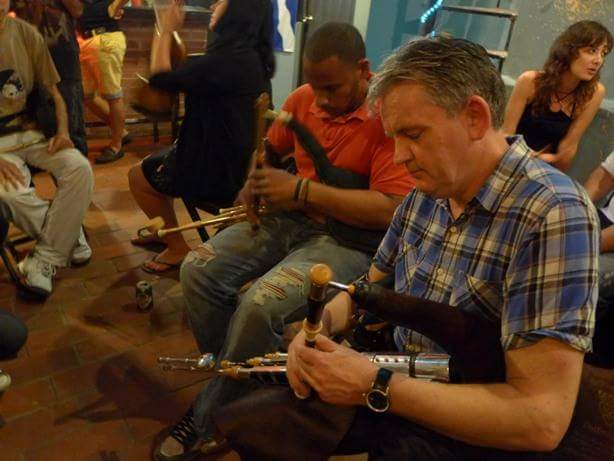
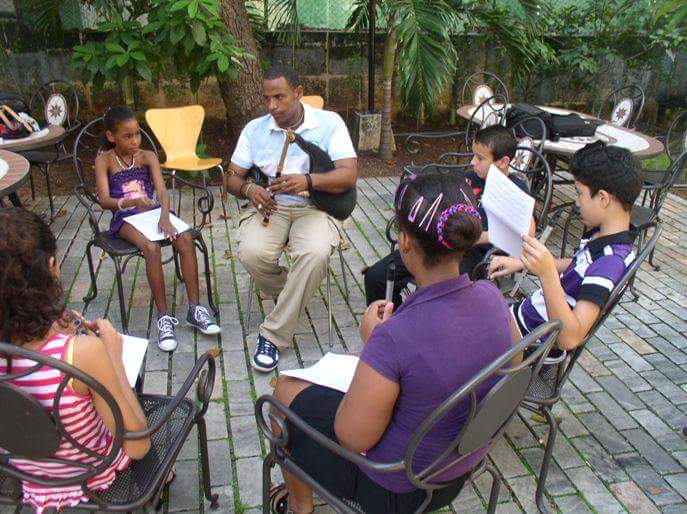
How many people play the uilleann pipes in Cuba today?
We got up to around 15, but some have left for other countries… Now there are very few of us — some young people who are learning, a girl from Pinar del Río who is a bit further along, her name is Rosalia Acosta Corrales. In Havana there are roughly 5 of us.
What are your goals or ambitions with these pipes?
For now, to teach them, and in the future to build something big. This is an instrument that takes a lot of work — both to get hold of and to spread its culture — and it is not the culture the Cuban is used to… it is more exotic and new than even Spanish music. The interest in traditional Irish music — not the kind we know from Riverdance — grew out of the 2010–2011 festivals. And that is truly traditional music, the way it is played in the countryside, with pipes, a snare drum, a bass drum and a tambourine… or in a bar, with a fiddle, an accordion, a guitar…
So, at some point will there be an Irish pipe band?
Hopefully. It takes a lot of work. Some people start and others get discouraged and look for something else.
Where have you played the uilleann pipes here in Cuba?
There have been a few events, but it is hard for us to get into venues because of the fact that one is not a professional musician — without a certificate it is difficult. We have worked with the Office of the Historian, the Barcelona–Havana Gallery, St. Patrick's Day at Hotel O'Farrill…
Have you travelled to Ireland to take courses? What was that experience like?
On two occasions, in 2014 and in 2017. That second trip was more about pipe-making, and this time not as a student but as a teacher. It is a very strange experience for a Cuban to go to Ireland to give classes on the uilleann pipes. Ireland is beautiful, very green, with a very strong traditional culture. Here in Cuba we have lost our love of tradition; over there, you might think the people who play this kind of music would be veterans, elderly folk with nothing better to do — but no, you can find children of 5, 6, 7, 10, 15 years old championing traditional music. During the holidays, many people spend their time going from one festival to the next…
Do you think an interest in Celtic music could undermine a sense of belonging to Cuban identity?
I don't think so. You always have to keep in mind where you were born, where you come from — that culture is yours to defend. I am a devoted fan of my Cuban music; I never stop listening to records by Los Van Van, Irakere, Pupi — the music we have grown up with from birth… It is not about replacing one culture with another… What I do think is wrong is turning our back on our own identity just to appear to be something we are not…
What have been the greatest satisfactions that playing the pipes has given you, beyond getting to know Ireland?
Meeting many people — important musicians I would otherwise have only seen in a video. Having those experienced musicians sit down and play with me as if I were just another Irishman. And, above all, meeting my wife; I met her at a festival and thanks to that I built my family. Getting to know my great teacher Gay McKeon, who has always been there for me to this day… The chance to play at the home of the President of Ireland… These are things you never imagine — one day you are sitting on your front porch and the next you are playing for the President of Ireland. That doesn't happen every day, not even over there…
You have touched on it already, but what are the most concrete difficulties of being a piper in Havana?
The instruments. Many times we have had to make them ourselves. The Galician pipes I have were built by Juan Carlos Prado and me. With the Galician pipes I have plans — in the future, thanks to Gay McKeon who has given us all the blueprints and specifications for the instrument — to start making them here so we can supply ourselves. And whoever comes to study will have to make the same sacrifices we all have.
Do you really believe there is an audience for this music in Cuba?
I think there is. I have been to some gatherings and you can see that people enjoy it.
Who are your main references within the genre?
There are many. The traditional music I draw from comes from old pipers, the foundational players. This kind of music is not learned in school — it is learned by ear: the older man sitting in a bar or at home, teaching his son or his grandson. That is why these are musicians who are mostly known within the world of traditional music. My teacher has to be there; Liam O'Flynn, who recently passed away and with whom I had the opportunity to play in concert; Leo Rowsome; Willie Clancy…
Why would you recommend listening to this kind of music?
It is relaxing. It sets me free. Listening to it is not the same as playing it — …when you listen it takes you off the planet, but when you are actually playing it, even more so… It transports you to those lands of Ireland, which are breathtaking.
The writer Gina Picart wrote in 2011, following the second edition of CeltFestCuba:
«…academic training is not indispensable for a musician, nor does the lack of it prevent anyone from being one. You are born a musician, and whoever does not carry that gene — which is like a gift from the gods — may spend their whole life crawling through the finest academies in the world and yet never become a true artist. The only thing that can prevent a musician from being one is the absence of an instrument.»
Alexander is currently a member of the excellent Cuban melodic metal and folk band, Saloma.