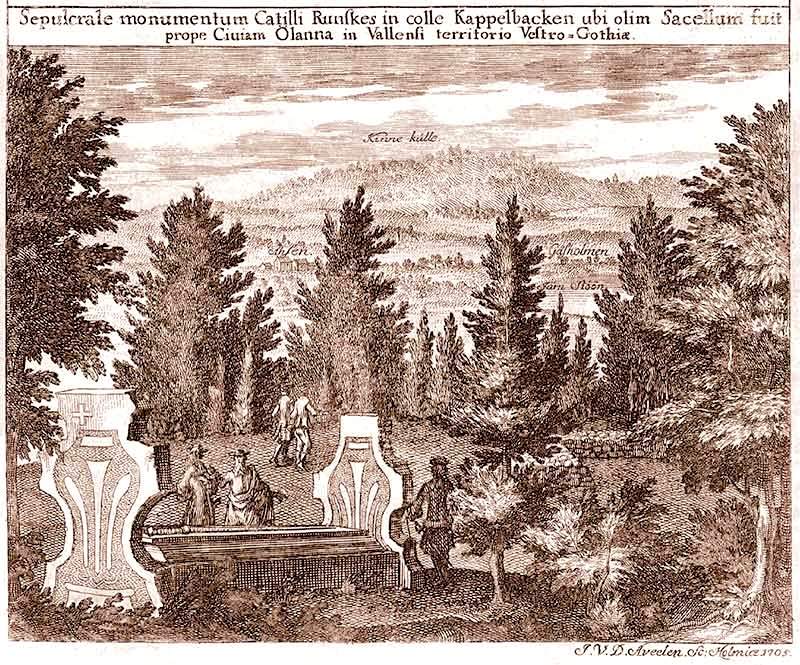
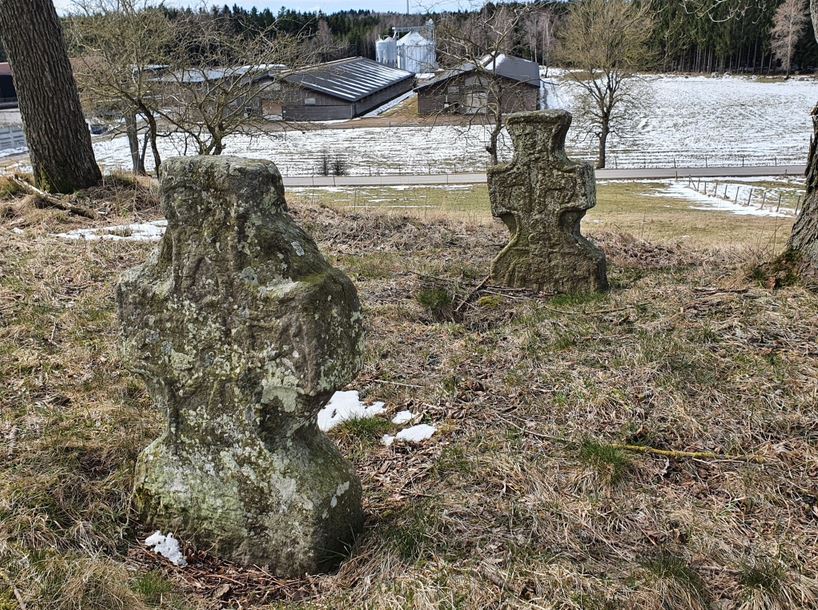
Kettil Runske is the hero of several folk tales that have been told for centuries throughout Sweden, but chiefly in the region of Götaland and the shores of Lake Vättern, where they apparently had their origins. Runske means "knower of runes" and, according to legend, he gained this knowledge by stealing three runic staves from Odin himself. The first to record the story of Kettil was the Swede Olaus Magnus in 1555, in his celebrated Historia de gentibus septentrionalibus. As far as I know, the tales of Kettil have been translated into other languages very rarely, and even within Sweden he is no longer as famous as he once was. The following summary has been compiled by comparing several internet sources.
Important note
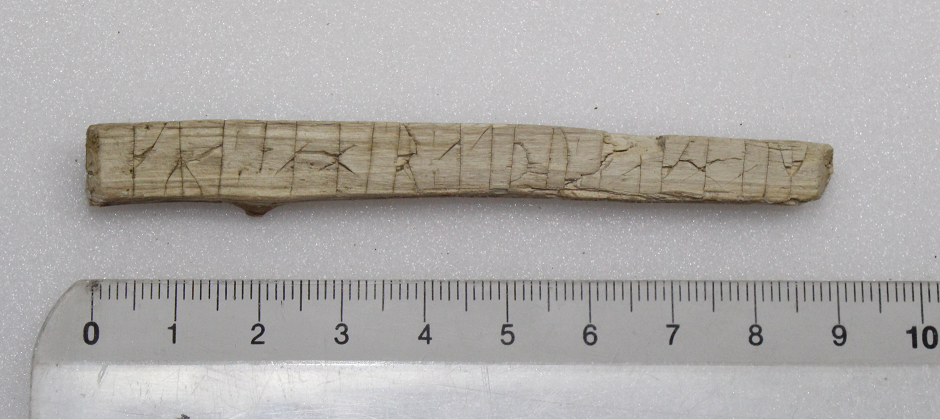
Inscription on a stick (12th century – Bergen, Norway) found in an area of the harbour where there were many resting places for sailors and residents. The text reads: "Gyða segir at þú gakk heim", which translates as "Gyda says that you should go home".
The term "runic stave" is used several times below. It is an element that presents some complexity in translation. Originally a runic stave is a piece of wood carved or inscribed with runes; in fact, when wood ceased to be used as a medium, the words for 'stave' or 'stick' continued to be used to refer to runic letters and symbols (magical or otherwise), even when written on bone, metal, parchment or paper. A runic stave is therefore not necessarily the same as a wizard's staff — that is an image from modern fantasy. In some contexts it may be interpreted as a single magical symbol, and in others as a piece of wood of varying size inscribed with runes; the well-known runic calendars, which have nothing magical about them, are also considered staves.
You might also be interested in reading:
1. Kettil's origins and the theft of the runes
In Möre, in southern Sweden, there was once a beautiful beech grove on a hill known as Torsås. One day, a young and wealthy farmer arrived on horseback and heard wonderful music and singing that seemed to come from within the stones. He stood still to try to make out the true source of the sound and found a door giving access to the interior of the hill. He was about to enter when two trolls came out. They greeted the farmer courteously, invited him inside and offered him a drinking horn.
Curious, he asked whose hall this was and what was the occasion for the feast and the merriment. His host, an old and wise troll, rose to his feet and said that his name was Tore, lord of the hill and the grove, master of that hall. The reason for the celebration, he said, was that his eldest daughter was being married to a mountain troll from Åland. Seeing that the farmer wore fine and costly clothes, he thought he must be wealthy, and went on to say: "If you wish, you too may marry one of my daughters. And if you treat her well, your children will grow to be very famous." The farmer accepted the offer, married the old troll's younger daughter, and the two of them had a son named Kettil.
Kettil grew up tall and strong. In summer he herded his father's goats, and one day he met another young shepherd who became his friend. On one occasion he followed his companion home with the intention of spending the night together. In the house a stout, bearded man lay sleeping, and next to him on the wall hung a strange box. Kettil asked his friend what box that was and was told: "It is my master's rune box and we are not permitted to touch it." They then went to sleep.
In the morning Kettil woke before the others and found himself unable to resist his curiosity, so he stole the rune box very quietly, concealed it in his cloak and went off into the forest. When he opened it, he found three runic staves inside. The moment he touched them he understood all the secrets of the runes.
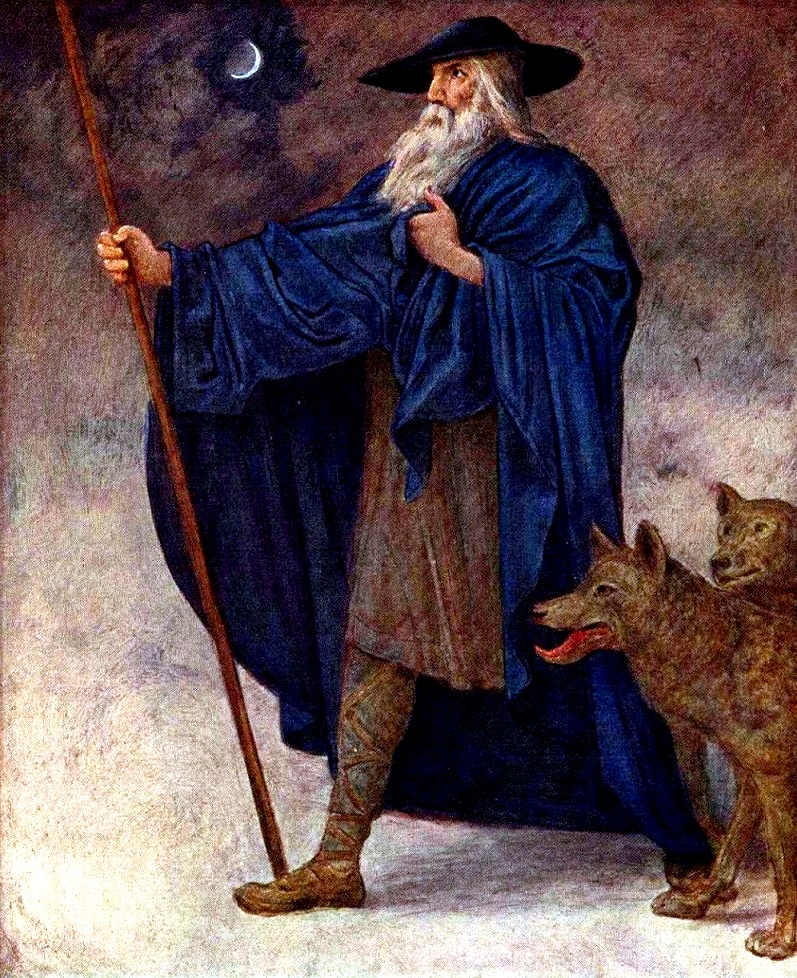
The following morning the bearded old man came to find him. He wore a broad-brimmed hat that shadowed his eyes, and he was accompanied by two fierce black wolves with foam on their fangs and eyes glowing like embers. Kettil understood that this man was none other than Odin himself. "Return what is mine or you will answer to my wolves," said Odin. But Kettil refused, and the wolves attacked him. At once he threw the first runic stave and the animals' paws stuck fast to it. "Release my wolves!" Odin demanded. But Kettil said he would only do so if Odin promised they would do him no harm. "Very well, they shall never trouble you again," said Odin, "but tomorrow I will return and give you a great fright." As soon as Odin left, the runic stave flew back into Kettil's hand.
The next day Odin returned, and this time he brought a bull, so strong and fierce it could have levelled an entire forest. Once again he demanded the return of what had been stolen and threatened Kettil. But Kettil threw the second runic stave at the bull's feet and brought it to a standstill. For the second time Odin had to abandon his claim and depart empty-handed.
On the third day Odin came back. This time he brought the Lady of the Sea, and she threatened to drag Kettil down to the depths of the ocean if he did not return the rune box. Once again Kettil showed no fear and refused. He immediately threw the third runic stave and brought the Lady of the Sea to a standstill. Odin finally conceded defeat and allowed Kettil to keep the runic staves and use their magic.
Once he had become a great sorcerer, Kettil left his home and travelled through many lands. It is said that he taught the people of Garðaríki how to write and that he won great fame in Estonia, Courland, Livonia, Lithuania, Prussia, Wendland, Denmark and Norway, as well as in Sweden and Götaland, becoming known everywhere as Kettil Runske.
You might also be interested in reading:
2. Kettil binds the monster of Storsjö
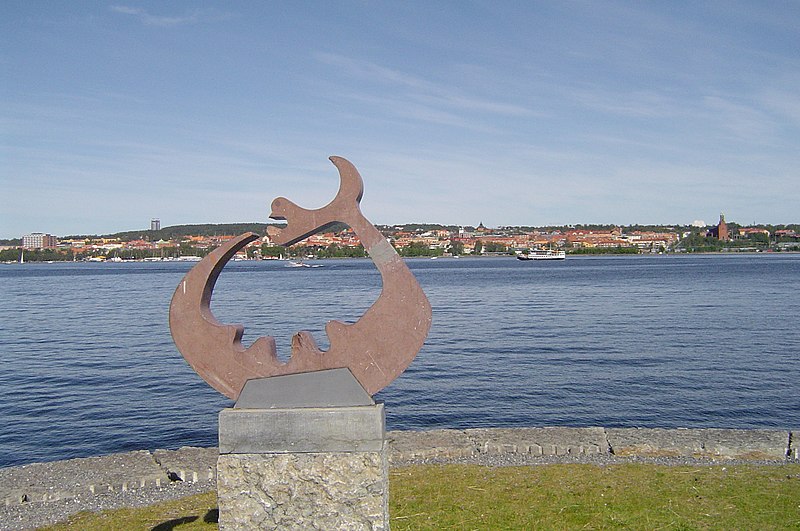
Once, Kettil arrived at Lake Storsjö in Jämtland, which had long been terrorised by a dreadful monster. He was curious and asked the chief of Frösö island about the creature's story. This is what he was told:
"Long ago, two trolls named Kata and Jata lived on the shore of Storsjön and were cooking something in a great cauldron. They cooked for days, weeks and years, wondering what would come of it. One night a strange sound was heard from inside the cauldron. Something groaned, shrieked, screamed and finally burst like a thunderclap. A strange creature with the body of a black serpent and the head of a cat leapt from the cauldron and vanished into the lake. The monster thrived in the water, grew enormously over the years and sowed terror among the people. Now it is so large that it encircles the island of Frösö and is able to bite its own tail."
Kettil resolved to rid the people of that curse, and so he carved a powerful runic spell into a stone [the famous Frösö Runestone] to bind the monster to the bottom of the lake. There it will remain until someone is able to read the runes and set it free once more. Kettil was richly rewarded with gold for this deed. He then travelled south to Götaland, where he bought a farm and settled in Habo on the shores of Lake Vättern.
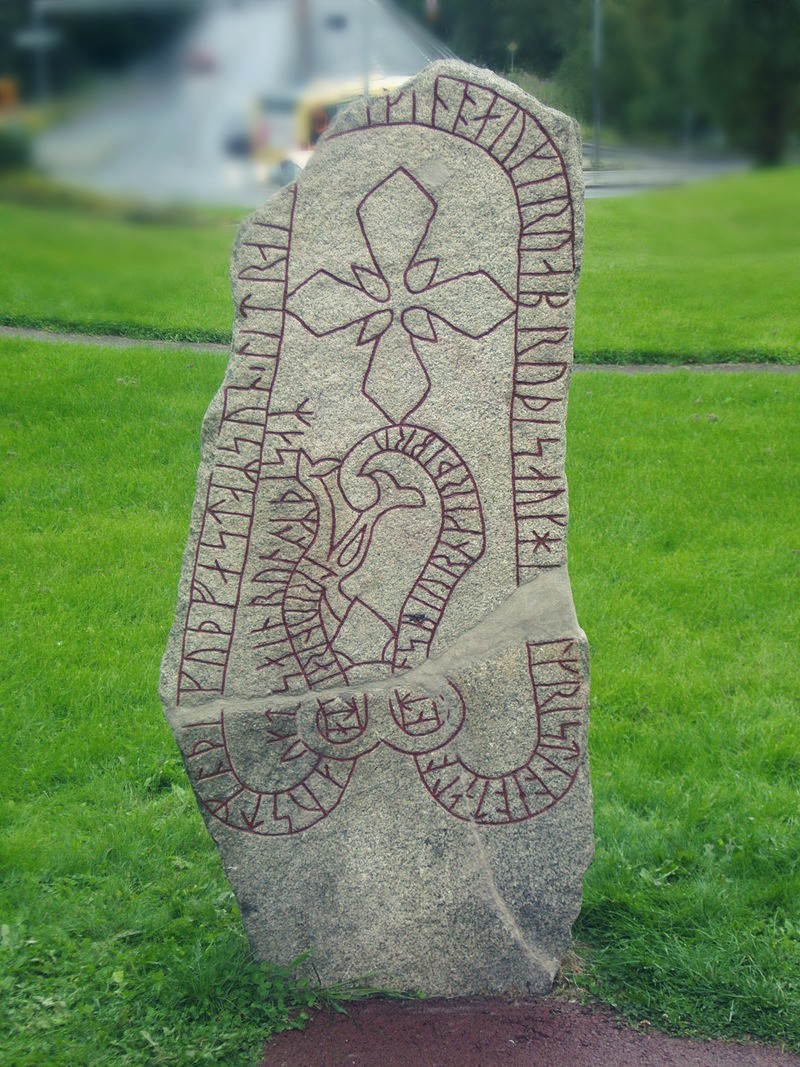
It is clear that the Frösö Runestone, catalogued in Rundata as J RS1928;$66, was linked to the legend at a late date, in an era when the reading of runes was no longer commonplace. It is even possible that the stone itself gave rise to the legend, since it bears a carved serpent biting its own tail — a fairly common motif on such monuments. The runic inscription reads: "Austmaðr, the son of Guðfastr, had this stone raised and this bridge built, and he Christianised Jämtland. Ásbjörn built the bridge. Trjónn and Steinn carved these runes." The stone's inscription is dated to the eleventh century, and the story of the monster appears for the first time in a manuscript of 1635.
According to another version of the story recorded a few years after the first:
"It is said that beneath this [runic] stone lies the head of a terrifyingly large serpent and that the body extends across Storsjön to the village of Knytta and Hille Sand, where the tail is buried. The serpent is regarded as a rå [guardian spirit] and it was for this reason that the stone was raised. As no one could cross [Lake Storsjön] in peace, the ferryman and his wife stated, along with many others, [that this was because] the stone had been toppled and broken in two during the upheavals of recent times. While the stone lay on the ground, many strange things occurred on the water, until it was raised and repaired."
3. The imprisonment of the sorcerer Gilbert
In those days, two kings held court on the island of Visingsö in Lake Vättern — one in the south at Näs, and another in the north at Borga. The two had long been quarrelling over the placement of their borders, and so the king of Näs decided to divide the island in two equal halves and put an end to the dispute. To carry out the work he summoned the giant Gilbert, a former pupil to whom Kettil had taught magic, and who by now had a reputation for great power.
When the king of Borga saw Gilbert using his magic to dig away great chunks of the island, he grew furious and tried to persuade him to stop, but the giant refused. The king then sent a messenger to fetch Kettil. Kettil came by boat, but he was invisible, and the people only knew he had come ashore when the vessel suddenly grew much lighter. Kettil found Gilbert digging to the north of Kumlaby and tried to speak with him to dissuade him, but Gilbert answered with shouting and insults and refused to stop. Finally, when Kettil threatened to use his powerful magic, the other said: "It would be a sorry sight to see a master fighting his apprentice. Let us settle our differences with a drinking contest instead."
Kettil agreed and they met the following night, each bringing seven barrels of ale. Cunning as he was, Kettil had fitted false bottoms into his barrels and had filled them with a weak brew, so that he could empty them quickly, while Gilbert took much longer and ended up drunk.
In a burst of rage the giant roared: "Before you beat me, we still have to fight!" "Very well," replied Kettil, and threw one of his runic staves at Gilbert — but he missed and it fell to the ground. Gilbert picked it up triumphantly, intending to hurl it back at Kettil, but found that it had stuck to his hand. "Push it away with your other hand!" Kettil called out. Gilbert tried, but found that now both hands were stuck. "Shove it away with your feet!" said Kettil, but this only caused Gilbert's feet to stick as well. Finally Kettil advised him to bite it with his teeth, and these too stuck fast to the runic stave. Thus the sorcerer Gilbert was made prisoner by Kettil Runske and laid upon a bear skin in the pit he himself had dug. Then Kettil spoke this spell: "Count one year for every hair that falls from this skin, for you shall not be free before that time."
It is said that Gilbert still lies bound deep in the pit at Kumlaby, and it is still called Gilbert's Hole to this day.
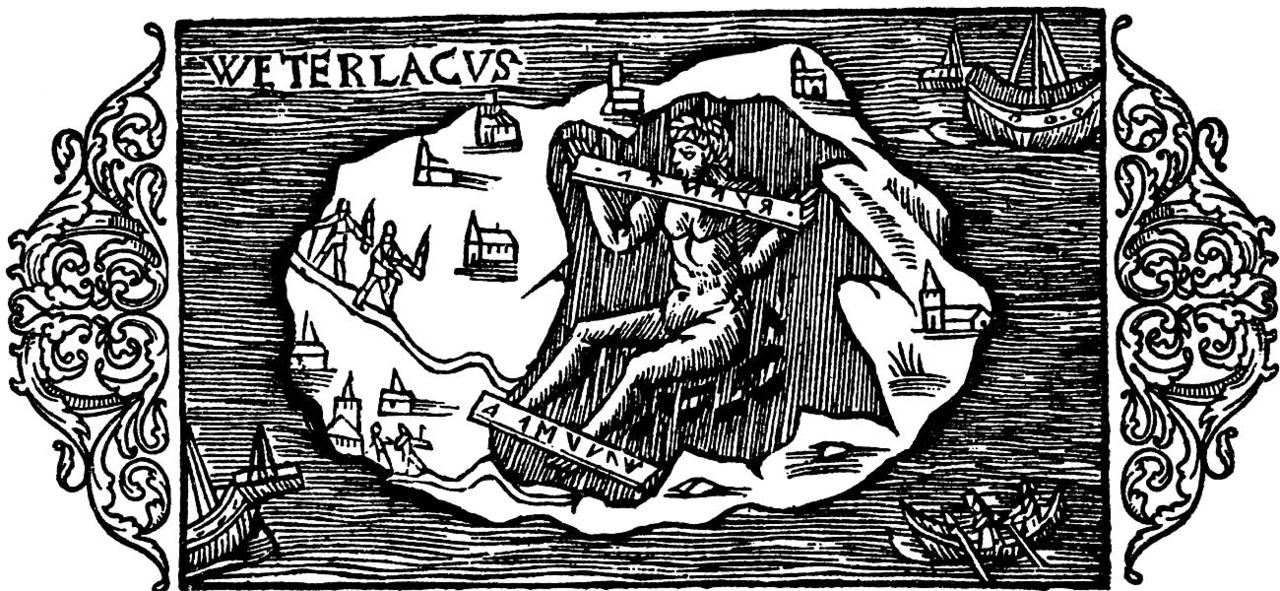
This Gilbert seems to be a blend of a bog-troll — since the area of the legend was once marshy — and a caricature of Pope Sylvester II, whose secular name was Gerbert of Aurillac (France, 945 – Rome, 1003); the famous pope of the year 1000 had earned himself a reputation as a necromancer on account of his devotion to the sciences.
A genuine cave system does exist at the site described in the legend, though both its entrances collapsed long ago. The Swede Olaus Magnus, the first to record the story of Kettil in 1555, relates that: "Into this cave descend only vainglorious braggarts and persons driven by curiosity, who must then be provided with a lit lamp and a ball of thread to find their way out again. The chief motive for the descent is the desire to see a certain sorcerer called Gilbert, who through his black art (the cause of his downfall) had been defeated and chained in this place in ancient times by his own master Kettil, whom he had dared to challenge." Yet Olaus also tells us that even when the cave was open it was difficult to enter, since "the stench and poisonous fumes of the cave" put visitors at risk of "suffocation through difficulty breathing or constriction of the throat."
4. How Kettil defeated Taksteiner
Many years later, on the island of Gotland there lived a wicked and cruel man named Taksteiner, who even after death returned to torment the living. The people of Gotland therefore decided to seek help from the great sorcerer Kettil Runske. It is said that Kettil walked to Gotland along the bottom of the sea, breathing through a magic cup.
When he arrived, he was taken to Taksteiner's tomb, but the dead man had made himself invisible and was nowhere to be found. However, Kettil knew a way to make him reveal himself. He took a white horse and mounted it backwards. He then took a silver spoon and pretended to eat from the horse's hindquarters. When Taksteiner saw all this he could not contain himself, and burst out laughing: "I have seen madness and I have heard madness, but there is no one madder than you."
Immediately Kettil threw a runic stave at him and brought him to a standstill. He then hurled him into the depths of his tomb and sealed the gravestone with lead, saying: "Rest here until the lead rusts!" "I can wait without any trouble," Taksteiner answered from within. Then Kettil placed seven barrels of linden charcoal over the tomb and said: "Then stay here until this rots!" And Taksteiner answered with a lament: "That will never happen." And so he could never again come out to trouble the living.
It is said that Kettil Runske lived to a great age, and there are many more stories about his deeds. Among other things, it is said that he slew the giant Hvitvalder and found a spring of fresh water in Resmo by following his nose. He finally died of old age and was buried in Ölanda, in West Götaland, where his tomb can still be seen.